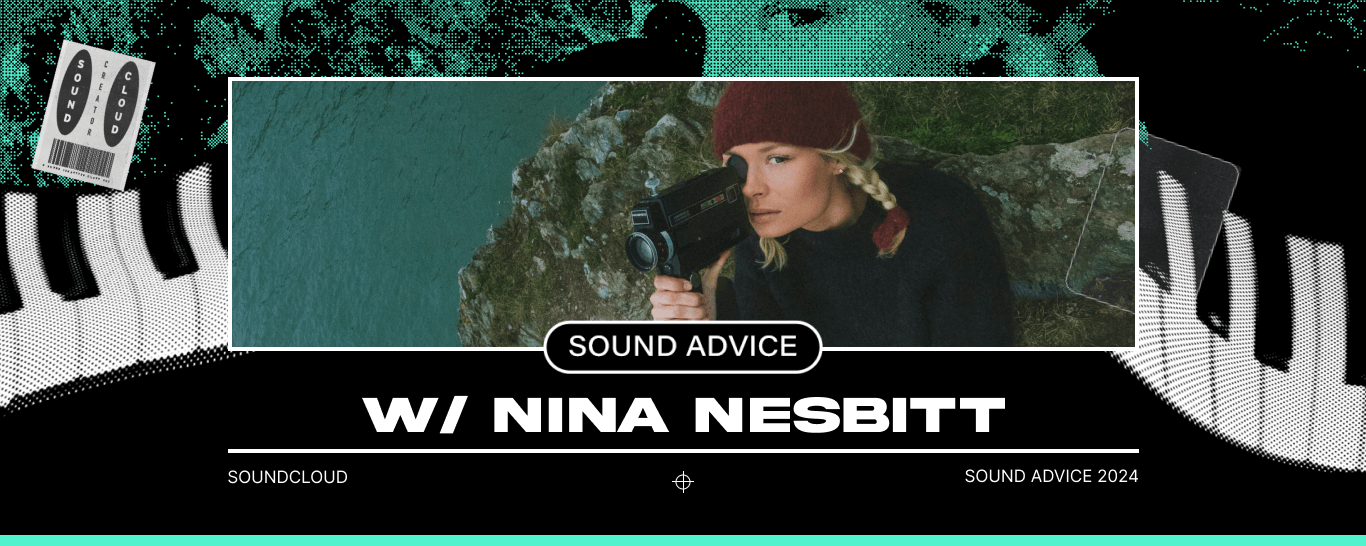

The Scottish singer/songwriter offers tips on sharpening your songwriting skills, growing your career and engaging fans authentically.
Welcome to Sound Advice, the weekly interview series spotlighting artists’ creative process and their SoundCloud journey. We’ll get the inside knowledge straight from the source on how musicians, producers and creatives are leaning into the many facets of Next Pro to reach their audience and grow their careers.
Scottish singer/songwriter Nina Nesbitt has been playing live from an early age; by the time she was 18, she had already done several headline tours around the UK, supported the likes of Ed Sheeran and Example and reached #1 on the charts with her second EP, ‘The Apple Tree.’ Features on big EDM hits by Feed Me and ILLENIUM brought her even more fans, as did a nod from her teen inspiration Taylor Swift, who co-signed her song “Last December”. After being in the limelight for over a decade, in the past couple of years, Nina had found herself ready for a change, both musically and creatively. However, a comprehensive US tour around her 2019 album, ‘The Sun Will Come Up, The Seasons Will Change & The Flowers Will Fall,’ as well as studio sessions songwriting for other artists, helped her rekindle a musical spark she had buried since her teenage years: her love of folk music. Her forthcoming album, ‘Mountain Music’ – which will be self-released on her new label Apple Tree Records in late September – is a declaration of independence that finds Nina connecting the dots between indie pop, Scottish traditional and American folk music, all anchored by her distinctive voice and a profound storytelling talent. We caught up with Nina in Scotland to talk more about the making of ‘Mountain Music,’ evolving your sound and building a fan base online and in real life using SoundCloud.
Why did you decide to call the new record ‘Mountain Music’?
I was in a record store that had every genre known to man and I’d seen ‘Mountain Music’ written. Also, one of my friends had done this essay, a dissertation on American Appalachian folk, and that was a phrase that he used. I loved that name. After delving into that, and discovering a lot of new artists coming from that area, I realized that a lot of the [Appalachian] settlers back in the day were from Scotland and Ireland. And I thought, I’d love to do a modern take on that music from a Scottish person’s perspective, but with a folky sonic background. I grew up on a lot of that folk music, [such as from] walking around Edinburgh and Scotland and hearing buskers. It’s very much about storytelling, so I’ve always been influenced by that music. But I felt like the artists I was listening to had a very [American] narrative with it, so I wanted to create something out of my own experiences.
What were some of your folk favorites growing up?
When Bon Iver released ‘For Emma, Forever Ago,’ I was obsessed with it, and I wanted to move to a cabin in the middle of America somewhere. Bright Eyes, I listened to a lot of that. And I remember discovering Lucy Rose when I was younger – she’s a British artist that has that very intimate folk sound that allows the storytelling to happen. And, of course, my beloved Mumford & Sons. Last year, I became a songwriter for other artists. I kind of fell out of love with music as an artist, and I didn’t really know what direction I wanted to take. So I listened back to a lot of this stuff and that really inspired me to pick up a guitar again and just write some good stories over music.
Did writing for other artists make it more clear what kind of songs you wanted to write for yourself?
Yeah, definitely. You meet all these artists who are so set in their lane and they know exactly who they are. That was really inspiring for me because it made me think, ‘What do I want to stand for? Who do I want to be?’ With each album, artists have the experience of reinventing themselves and I think it’s what keeps it exciting for me. Working in so many different genres – the K-pop world, R&B, dance – has made me realize what my strengths and weaknesses are. I think lyrics and storytelling has always been the thing that I naturally gravitate towards, and writing for piano and guitar.
Learn more about getting started on SoundCloud.
What was the creative process of making ‘Mountain Music’ like compared to your other records?
I think I’ve always known I wanted to make an album like this, but I’ve always thought it’s not the right time. There’s been a lot of pressure on me from the industry to have radio songs and stuff like that. With this album, I didn’t have any of those constraints. I didn’t even plan on making the album, I was just writing because I truly loved it; it felt very free, very stream of consciousness. Ten out of the 12 songs are literally just me 100% writing by myself here in this room at home. When I started out, I didn’t have co-writers and I just trusted my own instincts and I didn’t second-guess anything. From working with so many other people, I had lost confidence in my own opinions – this record really brought that back. For anyone who is starting out, that’s such a magical time to be creating, because you don’t have any success to compare it to or feel the pressure of – you're just writing because you want to. It was really nice to tap back into that feeling.
Was the studio experience any different on ‘Mountain Music’?
Yeah, definitely. I made all the demos here in this room. They weren’t electronic, but they had the same vocal processing I have on everything. I write a lot of pitch stuff for pop so I have a specific vocal chain I use all the time. I recorded all the demos and then I knew I wanted to go somewhere different to record. I wanted a live band situation, kinda inspired by Nashville, just getting a bunch of musicians in a room. And where would I find that in the UK? Through some friends of mine, I got recommended Peter Miles [at Middle Farm Studios in South Devon, England]. I went down to the studio to check it out and I was just blown away by how perfect it was for what I wanted to do. He records on an old ‘70s tape machine. We gathered some live musicians in a room and just sort of went for it. When I played him the demos, he said, “I love the songs, but you sound like a robot. You need to ditch the Autotune and we need to make something very raw to do the songs justice.” That was quite scary; it’s like taking the stabilizer off in a way. It was uncomfortable to hear my voice so raw and imperfect, but it’s something I’ve grown to actually really enjoy.
Before you were “discovered,” you were already uploading acoustic cover songs and demos to the internet. From your teenage years to now, what have you learned about having fans and engaging them?
When I was first uploading to the internet, I just wanted to know if people thought I could sing. I didn’t really think it could be a career because it was at those early stages of these web platforms where I think people didn’t really understand the impact that gathering a fan base on the internet could have. And then my first EP went into the iTunes charts and it was a huge wake up call for me that this could be a career, especially coming from a village in the middle of nowhere with no music industry contacts. Having these things like SoundCloud just felt like a road out of being invisible and really just gave me a platform to be seen and be heard; I’m very grateful for that. Over the years, people come and go but there’s a core group of people that were there from the beginning and it’s amazing to see they're still here, still at the gigs. In a way, we’re growing up together, which is really nice. You could have a viral hit these days or you could have loads of radio plays, but I think the main thing is the fan base and building the community. Now more than ever, I think what’s important for new artists starting out is building that community and figuring out what that community is. What do you want people to take away from your music and you as a person? That’s really important.
Learn more about getting heard on SoundCloud with Next Pro.
There’s a lot of pressure for artists to be constantly sharing on social media. How do you think about your social media presence and what you want to share?
I think everyone’s still figuring it out really. The older I’ve got, the less I want to share about my life. I don’t know if it’s just growing up and realizing you don’t need to post about what you’re doing all day long. Having time away from it last year was amazing. I felt the most creative and least anxious I’ve ever felt. Getting back into regularly posting on social media and having to think about that has been a lot. It gives me a lot of anxiety and I’m trying to figure out how to manage that. So much falls on the artists now, which is good and bad. First up, I started my own record label, because if I have to do most of [the work], then I may as well have full control over everything and enjoy that. So I’m just trying to create things that excite me and post things that have value. I do think there’s a bit of a misconception about how often you need to post – I’ve tried to post less but with more value hopefully.
What features of SoundCloud do you find most useful?
SoundCloud feels to me like when I first started, before I ever put stuff out ‘officially.’ It’s really good for building a community. You’re not asking anyone to buy or stream, it’s just putting things up on the internet – it’s less pressure for me. And you’re sharing music artist-to-fan, which feels quite nice. I’ve definitely done exclusive songs on SoundCloud; like if I’ve written a demo, I’ll share it with fans on there and not officially release it on streaming services or take it to radio. We’re always looking for ways to make it interesting and feel like an experience where fans are being let in on a secret thing. It feels very intimate, in a good way.
Learn more about using the Fans tool with Next Pro.
You’ve been in the public eye performing for quite a long time now, since you were a teenager. What advice do you have for artists who are just starting out playing live?
Try and do as many shows as you can. People underestimate how important live shows still are – to have people in a room that are there to just connect with you and your music is really valuable. And I think we underestimate the power of word of mouth. A lot of my day-one fan base are people I picked up on support or random headline gigs. You can really connect with people and meet them afterwards, hear what their favorite lyrics are or what tracks they’re enjoying, and I think it’s as valuable for you as it is for the audience. And also: message people. You don’t ask, you don’t get – so just go for it.
To discover additional features a SoundCloud Next Pro subscription offers, visit here. Click here to follow Nina Nesbitt and her journey on SoundCloud.








.png)



.png)




.png)


.png)


.png)











.png)