


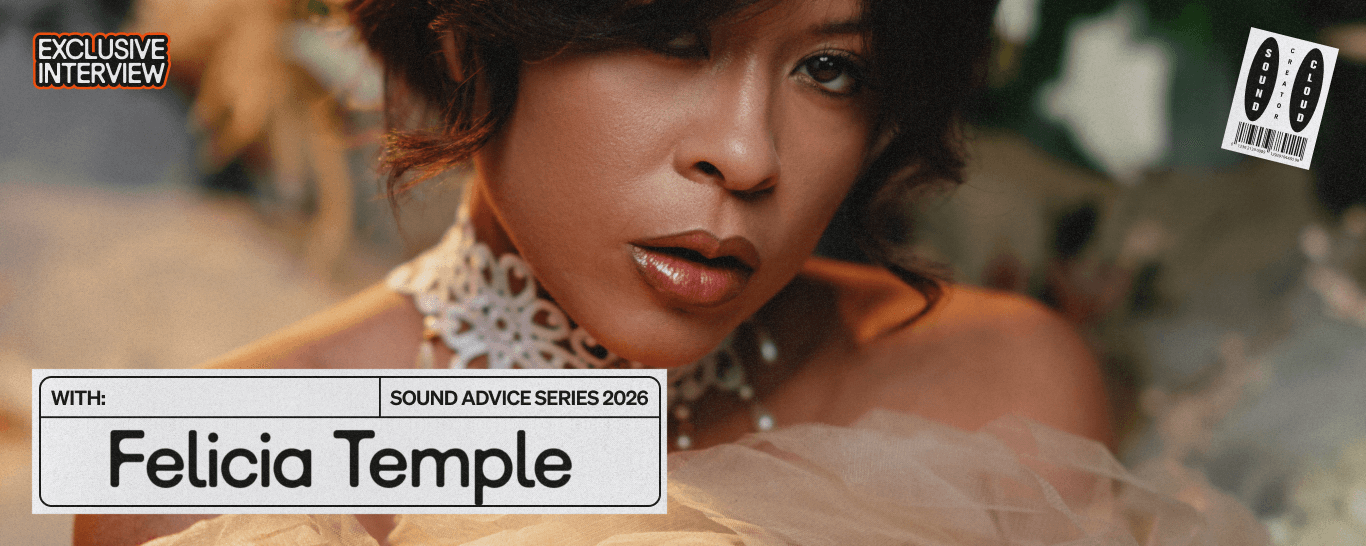

Join Felicia Temple on Sound Advice, the weekly interview series covering artists’ journeys and their creative process. In this episode, we discuss the R&B singer-songwriter’s new album ‘A Soft Place To Land,’ her musical origin story and advice on being a working independent artist today.
Welcome to Sound Advice, the series spotlighting artists’ creative process and their SoundCloud journey. We’ll get the inside knowledge straight from the source on how musicians, producers and creatives are leaning into everything SoundCloud offers to elevate their sound, get heard and catapult their careers. Sound Advice is now available in audio format on the SoundCloud Stories profile.
On this episode of Sound Advice, we talk to Felicia Temple, a soul-rooted R&B artist, songwriter, pianist and producer. She’s also a working registered nurse and a cancer survivor, who just self-released her fifth studio album, ‘A Soft Place To Land.’ You may have seen Felicia on Season 12 of “The Voice,” or singing backup for The Roots and John Legend. Or maybe you’ve come across her social media videos, where she drops real world, unfiltered artist advice — sometimes while wearing her nursing scrubs.
Born and raised in Teaneck, New Jersey, Felicia grew up around music: her grandmother was a cabaret singer and her dad was a house music vocalist, who later joined the classic hip-hop group The Sugar Hill Gang. Building on these strong foundations, she’s become a true independent artist, including self-funding and self-releasing top quality music videos and albums, as well as booking her own tours, and finding inspiration and creative freedom among the challenges.
In this engaging conversation, Felicia shares her journey and her artist vision, and talks about some of the lessons she’s learned from her life experiences. She emphasizes the significance of authenticity and investing in yourself, and reflects on the role of SoundCloud in getting her music to the masses.
LISTEN TO THE AUDIO EPISODE OF SOUND ADVICE FEATURING FELICIA TEMPLE
LISTEN TO ‘A SOFT PLACE TO LAND’ BY FELICIA TEMPLE ON SOUNDCLOUD
Things We Talked About In This Episode of Sound Advice
The Many Roles that Felicia Temple Plays on Her Latest Album, ‘A Soft Place To Land’
- On Felicia Temple’s latest album, ‘A Soft Place To Land,’ she wears many hats. As well as writing and singing her original music, as an independent artist, she’s behind all of the processes that bring an album into the world.
- To begin our conversation, she talks about her involvement with the financing, mixing, mastering and recording stages of her album, her collaboration with producer and engineer OB Brown, and how she uses Dolby Atmos to get her sound.
- As she explains, the quality of the recording matters to Felicia because she wants to convey the true emotions of her songwriting through the sonics as naturally as possible. For ‘A Soft Place To Land,’ she wanted to “go in a direction that felt calm, soft and introspective,” because the album explores a very personal time in her life. Here, she talks about how she achieved those sonics and what styles of instrumentation she focused on.
What Creative Freedom Means to Felicia Temple, and How to Harness Its Power
- Felicia is passionate about being an independent artist — so when did she realize that this was the right path for her, and what makes that path so important to follow? “The most important thing is freedom,” she says, but it’s not always an easy path to take.
- Freedom, as she explains, can be intimidating; if you’re a new artist, trying to figure out who you are, your sound and your audience, freedom can even be a “dangerous” thing and lead you to messy or undisciplined choices. But as you grow into your art and have a better understanding of yourself, freedom becomes a wonderful, powerful thing. That freedom is what allows Felicia to showcase her music authentically, because “anyone who listens to my catalog knows that each project has been like a diary entry to my life.” Here, she runs down her key releases, what the sounds and storytelling of each represent, and how they’ve narrated her life so far.
- If she’d been signed to a big record label, she says, “I wouldn’t have had the capacity to make such a wide range of music,” she says honestly. “Being indie means that I can do whatever I want, whenever I want — I just have to pay for it.”
What Appearing on “The Voice” With Alicia Keys Taught Her About the Music Industry
- Over the years, Felicia has had experiences with the music business and entertainment industry that have strengthened her resolve to be an independent artist. Here, she talks about watching her dad — a house vocalist and member of legendary hip-hop group The Sugar Hill Gang — struggle with record labels, touring and his artist rights, and how his experiences had an impact on her mindset.
- She also reflects on being part of major music TV show “The Voice,” and how that side of the business wants to move artists into “a package deal.” As she tells it, “You come in with so many ideas, but they already have a version of you to make and sell.” What she took from that time, she reflects, was her want to be creatively and professionally unrestrained.
- Her time on “The Voice” was very fruitful, though — and brought her a full circle moment with Grammy Award-winning artist Alicia Keys. Having grown up listening to her records, and using them to learn how to play piano, Felicia was fondly nicknamed “Felicia Keys” as a young girl. When she was on “The Voice” with Keys herself, Felicia got some sage advice from the legendary musician: “Remember, this is TV, and you are an artist.” It’s simple, she says, but it was vital for her to hear and made leaving the show that much easier to cope with.
- Every day, independent artists have to juggle myriad tasks and roles to get their music out into the world. So what has been the greatest return on investment — in terms of money, time, energy and attention — for Felicia? When she was on “The Voice,” Felicia learned a valuable lesson: just because you’re on TV, in front of millions of people every week, doesn’t mean that those views will automatically convert to fan engagement and streaming numbers. “They’re fans of a TV show, not you,” she says. A smart move that Felicia made was making sure that she already had an album, ready and waiting, to drop as soon as her season of “The Voice” ended in 2017.
Balancing a Day Job with Independent Music-Making, and Tips for Fellow Artists
- As she reflects, Felicia’s greatest learning moment, though, came in 2025; many years into her independent music career. By night, Felicia is a music recording artist. By day, she’s a registered nurse, working in hospitals in her native New Jersey. For many years, Felicia hid her daytime profession and presented a version of herself online, to her fans, that implied that she was a full-time musician. Over time, though, she realized that this was the wrong course of action: fans today want to relate to their favorite artists and build authentic connections, and by not being honest with her fans, Felicia realized she was stunted in her relationship with her supporters.
- In 2025, she opened up online about her day job, how she balances it with making music and the realities of being independent in today’s industry. Here, she talks about the incredible reaction she got from her listeners. “The maths doesn’t always math in music,” she says, “but I’m showing them that this is how I do it. You don’t need a high budget to make great art.”
- By engaging authentically and directly with her fans on social media, she’s come to some core advice. “Talking to the camera costs nothing,” she says. “Labels can fund a lot, but relatability can’t be beat or built.”
- When Felicia first started posting her music, she went directly to SoundCloud. Here, she talks about having been on the platform since her first album, ‘To Whom It May Concern’ — which, she says proudly, is still only available to stream on SoundCloud. Being on the platform from her very early days also led to her being discovered by others online. A YouTube creator, having heard the album, chose a track of hers as the theme song for their series, and Felicia’s listenership continued to grow from there.
- As the track comments flooded in, she loved seeing that organic engagement from new listeners. “When people felt something in a song, and I could see them reacting in real time to it, that showed me that people truly listen to the work” on SoundCloud.
How Felicia Temple’s Family Roots in House and Hip-Hop Inspired Her Creativity
- Growing up in New Jersey, Felicia was surrounded by quality music-making. Here, she talks about her cabaret-singing grandmother, gospel house-singing father, and how she came to sing, play piano and eventually tour with her father. By performing as a teenager at major dance music events like Winter Music Conference, and even sharing stages with vocal house legends such as Barbara Tucker and CeCe Peniston, she caught the performing bug and knew that this was going to be the direction of her life.
- However, her mother also had an important, grounding influence on her. When Felicia said she would be “a singer or die,” she jokes, her mother encouraged her to get a day job, so as not to pin her whole future on success within the music industry. That balance of family guidance, she shares, is what made her who she is today.
- That upbringing also instilled a guiding principle in her. “You’ve got to really feel it in your bones that you want to be an artist,” she says, because there’s much to see and hear that would make a reasonable person quit this line of work; “but we’re tethered to our gift,” she says, of artists.
- It’s in her nature to create, whether there’s a paycheck in it for her or not. Here, she talks about how she’s come to the understanding that “If I’m authentic, there will be an audience to receive it,” even if the means of reaching that audience change and evolve over time.
Reaching New Audiences with Social Media and Raw Authenticity
- One way that Felicia has been reaching her audience recently is through her personal social media videos. Recording from her hospital in her scrubs, she’s been waxing lyrical about the realities of independent artistry, the music industry, and how she balances a nurse’s full-time schedule with all elements of her musicianship, from writing and recording to touring, marketing and other business-related affairs.
- Here, she reflects on why she’s been making these videos, how what you take as common sense and knowledge is often great new information for others — and can often be the permission that others need to follow their own dreams, too.
- She also speaks openly about how she’s come up against those in the industry who have judged her for having a day job, and what she’s learned from those interactions. These have been moments of clarity for her.
Felicia Temple’s Honest Advice on How to Focus on Your Musical Craft and Get Ahead
- In the spirit of sharing advice, she also passes on some words of wisdom to up-and-coming artists, who might feel unsure of what to spend their money on in order to really break through. On this, Felicia focuses on a theme: focus on your strengths, and pay others who can cover your weaknesses. The main one she believes is in paying to do proper studio recording sessions with engineers and producers.
- While the majority of up-and-coming artists understandably use home recording and production equipment, speaking honestly, Felicia says it’s often hard to get a real technical grip on those processes if you don’t have any guidance from knowledgeable people. The best thing, then, in her mind, is to get the very best out of your voice and music by collaborating with talented individuals in a studio setting. By focusing on sound quality, your music will travel further.
- Another key bit of advice, on this theme, is to not be scared of hiring people to help you with all of the roles required to really get your music out into the world. From management, publicity, booking events, production, writing, DSP and label representation, there’s a whole ecosystem of roles that can take some weight off the shoulders of an independent artist, which allows you to focus on making your music the very best it can be. “Know what drives you crazy, so you can avoid doing that yourself,” she says. “Money spent making a problem go away is money well spent!”
- Now that ‘A Soft Place To Land’ is out in the world, what could we hope to see and hear from Felicia Temple in the future? Here, she shares her dream of, one day, being able to work with an orchestra, on some “1990s Disney-style pop ballads,” she says brightly. Until then, you can listen to her latest album here.
Links and Extras
Follow Felicia Temple’s journey on SoundCloud.
Press play on Felicia Temple’s 2025 album, ‘A Soft Place To Land.’
Go back to where it all began with Felicia Temple’s debut album, ‘To Whom It May Concern.’
Explore some of Felicia Temple’s wide-ranging influences, including Alicia Keys, Mariah Carey and Lauryn Hill, to name a few.
Listen to the Soul’s New Era playlist on SoundCloud.
Never miss an episode and follow the official Sound Advice playlist on SoundCloud.
Getting The Most Out of SoundCloud
Learn more about using DMs to connect with fellow artists and potential collaborators.
Learn more about how to make a custom playlist on SoundCloud.
Learn more about unlimited uploads, available with an Artist Pro subscription.
Learn more unlocking access to unlimited distribution, available with Artist Pro.
Learn more about getting heard with SoundCloud’s updated algorithm, available to Artist and Artist Pro subscribers.
To discover additional features a SoundCloud Artist or Artist Pro subscription offers, visit here. To catch up on past installments of Sound Advice and make sure you don’t miss out on future episodes, visit here.
CREDITS Host: Vivian Host, Executive Producer: Mike Spinella, Producer: KC Orcutt, Audio Engineer: David “DibS” Shackney, Coordinator: Trevor McGee, Editorial Associate: Lauren Martin





















.png)


.png)





.png)














.png)






.png)


.png)
